
Scholarships & Applications
How to Find Scholarships You're Actually Eligible For: A Step-by-Step Guide
Finding scholarships is one thing. Finding scholarships you actually qualify for is another. Learn how to evaluate eligibility requirements, identify credible opportunities, understand funding, and build a focused scholarship shortlist.
You find a scholarship that sounds perfect.
It covers tuition, offers a living allowance, and supports a degree you've always wanted to pursue.
You get excited, bookmark the opportunity, and start imagining what studying abroad could look like.
Then you read the eligibility requirements.
Your country isn't listed. Your degree doesn't meet the minimum requirement. Or the scholarship is only available to applicants with a particular academic or professional background.
Just like that, an opportunity that looked promising is no longer an option.
This is one of the most frustrating parts of searching for scholarships.
The problem isn't always finding scholarships. It's finding the right scholarships for your background, qualifications, and goals.
The good news is that you can make this process significantly more focused.
Instead of applying broadly and hoping something works out, you can learn to identify opportunities you're genuinely eligible for, evaluate how competitive your application might be, and prepare more strategically.
Here's how.
1. Understand the Difference Between Scholarship Eligibility and Competitiveness
Before searching for scholarships, it's important to understand two concepts that are often confused.
Eligibility is about whether you're allowed to apply.
Competitiveness is about how strong your application is compared with other eligible applicants.
For example, imagine a scholarship requires:
- A bachelor's degree.
- Citizenship of an eligible country.
- A minimum academic qualification.
- Admission into a supported master's programme.
You meet every requirement.
That makes you eligible.
But the scholarship may also evaluate leadership experience, academic achievements, community involvement, career goals, and the quality of your application essays.
Those factors influence how competitive you are.
You can be eligible without being a particularly strong candidate.
Likewise, you might have impressive achievements but still be ineligible because you don't satisfy a mandatory requirement.
Your first task is to establish eligibility. Your second is to demonstrate suitability.
Keeping these two stages separate will help you avoid spending time preparing applications for opportunities you cannot pursue.
2. Build Your Scholarship Eligibility Profile
Before opening another scholarship website, take a moment to document your own academic and professional background.
Think of this as your scholarship eligibility profile.
It should include the information scholarship providers commonly use to assess applicants.
Your academic background
Record:
- Your highest academic qualification.
- Your degree classification or GPA.
- Your field of study.
- Your institution and country of study.
- Your expected graduation date, if you're still studying.
- Any relevant certifications or academic achievements.
Be accurate about your qualifications.
For international applications, also understand how your academic results may be interpreted in the destination country's grading system.
A degree classification in one country may not translate directly into another country's classification.
Where necessary, consult the university's official international qualification guidance rather than making assumptions.
Your personal eligibility information
Include relevant details such as:
- Citizenship or nationality.
- Country of residence.
- Intended study destination.
- Preferred level of study.
- Preferred field or programme.
- Professional experience.
- Language proficiency.
- Funding needs.
Certain scholarships have additional conditions related to age, employment, leadership, financial circumstances, or previous scholarship awards.
These are not universal requirements, but they may matter for specific programmes.
Your academic and career goals
Finally, clarify what you actually want to study and why.
Are you pursuing a master's degree to deepen your expertise?
Are you transitioning into a different professional field?
Do you want to undertake research?
Are you looking for a professional development programme rather than a full academic degree?
Your answers should influence which opportunities make your shortlist.
The goal isn't to find every scholarship available. It's to identify the ones that align with where you are and where you want to go.
3. Learn to Read Scholarship Eligibility Requirements Properly
Scholarship announcements can contain a substantial amount of information.
A common mistake is reading the benefits and application deadline while overlooking the conditions that determine who can apply.
When evaluating a scholarship, pay particular attention to the following areas.
Nationality and residency requirements
Some scholarships are open internationally.
Others are restricted to particular countries, regions, or residency categories.
For example, individual Commonwealth Scholarship programmes have their own lists of eligible countries.
Being from a Commonwealth country doesn't automatically mean you qualify for every Commonwealth-funded award.
Always confirm the eligible-country list for the specific programme.
Academic qualifications
Look beyond statements such as "a good bachelor's degree."
Check the actual academic standard required.
Some programmes specify degree classifications, GPA thresholds, prerequisite subjects, or recognized qualification equivalents.
Others allow applicants who are still completing their degrees, provided they graduate before a specified date.
Field of study and programme restrictions
A scholarship may support particular universities, courses, departments, or research areas.
A fully funded scholarship for postgraduate study doesn't necessarily cover every postgraduate programme.
Check whether your intended degree and university are eligible.
Work experience requirements
Some scholarship programmes require professional or leadership experience.
Others are open to recent graduates or applicants without formal employment experience.
For instance, Chevening has specific work experience eligibility requirements, while Commonwealth scholarship requirements differ by programme.
Don't assume that all prestigious scholarships follow the same rules.
Language requirements
A scholarship provider and the university offering the degree may have different language requirements.
For example, a scholarship might not require an English-language test during its initial application process, while the university may still require proof of English proficiency before admission.
Always check both.
Additional obligations
Certain scholarships include conditions that extend beyond admission and funding.
These may involve:
- Returning to your home country after completing your programme.
- Maintaining satisfactory academic progress.
- Studying full-time.
- Meeting visa requirements.
- Avoiding incompatible funding arrangements.
These conditions matter just as much as the benefits.
A scholarship is only a good fit if its requirements and obligations align with your circumstances and long-term plans.
4. Know Where to Find Credible Scholarship Opportunities
Once you understand your eligibility profile, the next step is to discover relevant scholarships from trustworthy sources.
University scholarship pages
Start with the official websites of universities offering programmes you're interested in.
Look for sections titled:
- Scholarships and Funding
- Financial Aid
- International Student Funding
- Graduate Funding
- Research Studentships
Some awards are available automatically to eligible applicants, while others require separate applications.
Read the individual funding instructions carefully.
Government scholarship programmes
Governments and international organizations offer various scholarship programmes for eligible students.
Examples include:
- Chevening Scholarships.
- Commonwealth Scholarships.
- Erasmus Mundus Joint Masters scholarships.
- National government-funded scholarship programmes.
These can be useful starting points, but their eligibility conditions, benefits, and application cycles differ.
Always use the programme's current official website to confirm details.
Foundations and professional organizations
Private foundations, charitable organizations, industry bodies, and research institutions may also provide funding.
Some focus on particular academic fields, geographical regions, or underserved communities.
Others support applicants with specific research interests or professional goals.
Scholarship discovery platforms
Scholarship discovery tools can help you identify opportunities across multiple sources without manually searching every institution.
For example, Opportuna's scholarship discovery and readiness platform helps users focus their search using factors such as study level, destination, field, funding preferences, and eligibility information.
However, regardless of where you discover an opportunity, always verify its requirements and application instructions on the official provider's website before applying.
Discovery platforms should make searching easier, not replace official verification.
5. Understand What "Fully Funded" Actually Covers
The phrase fully funded scholarship can be exciting.
But before celebrating, examine what the funding actually includes.
Depending on the award, funding may cover some or all of the following:
- Tuition fees.
- Monthly living allowance or stipend.
- Travel expenses.
- Health insurance.
- Visa-related costs.
- Research or academic expenses.
- Relocation or settlement allowances.
Not every scholarship covers the same combination of expenses.
Even where tuition and living expenses are included, additional personal costs may remain.
For example, you might still need to budget for accommodation deposits, family expenses, particular travel arrangements, or other costs that aren't explicitly covered.
Before adding an opportunity to your final shortlist, answer these questions:
- Does the scholarship cover full tuition or only part of it?
- Is a living allowance provided?
- Does the allowance realistically support the destination's living costs?
- Are travel, visa, and insurance expenses covered?
- Are there conditions or restrictions on the funding?
- Are there expenses I would still need to finance myself?
A scholarship's value isn't determined only by how much funding it advertises, but by how well that funding meets your actual needs.
6. Create a Scholarship Shortlist Instead of Applying Everywhere
A focused shortlist helps you spend your time on opportunities that deserve it.
Rather than keeping dozens of unorganized browser bookmarks, create a simple tracking system.
For every scholarship, record:
- Scholarship name and provider.
- Official application link.
- Eligible countries.
- Supported study levels and fields.
- Academic requirements.
- Funding coverage.
- Required documents.
- Application deadline.
- Your eligibility status.
- Your next action.
Then classify each scholarship into one of four categories.
Category A: Eligible and well-aligned
You meet the mandatory requirements, and the scholarship fits your academic and career goals.
These deserve serious consideration.
Category B: Eligible but highly competitive
You meet the requirements, but your application may need stronger evidence of leadership, impact, academic preparation, or another selection criterion.
These may still be worth pursuing.
Category C: Potentially eligible, pending clarification
You meet most requirements, but an important detail remains unclear.
Perhaps your degree classification needs verification, or you need to confirm whether your programme is supported.
Contact the scholarship provider or university before investing significant effort.
Category D: Ineligible
You don't satisfy a mandatory requirement.
Remove the opportunity from your active application list unless the provider explicitly offers an alternative eligibility route.
This simple classification can save you substantial time.
7. Evaluate Your Competitiveness Before Applying
Now that you've identified suitable scholarships, ask a different question:
What evidence makes me a strong candidate for this particular award?
Scholarship selection committees may consider academic merit, leadership, relevant experience, community impact, research potential, career direction, or other programme-specific criteria.
Your responsibility is to understand what matters to the provider and demonstrate it convincingly.
Example: Two applicants with similar qualifications
Imagine two applicants applying for a scholarship supporting technology and social impact.
Both have strong academic records.
Applicant A writes:
"I am passionate about technology and want to use my education to make a difference in society."
Applicant B explains:
"During my undergraduate studies, I developed an accessible learning prototype for students with visual impairments. The project helped me identify limitations in existing assistive technologies and shaped my interest in further research."
The second response is more persuasive because it connects a specific experience to the applicant's proposed direction.
It gives the reader something concrete to evaluate.
The lesson isn't that every scholarship applicant needs an extraordinary achievement.
It's that specific, truthful evidence is more useful than broad claims about ambition or passion.
Review the selection criteria and identify examples from your own academic, professional, volunteer, or personal experiences that demonstrate relevant qualities.
8. Prepare Your Documents Before the Deadline
One of the biggest advantages of a focused scholarship search is that it gives you more time to prepare.
Many scholarship applications require several documents, and some take longer to obtain than applicants expect.
Common requirements include:
- Academic transcripts.
- Degree certificates or proof of expected graduation.
- Academic or professional CV.
- Statement of purpose or personal statement.
- Letters of recommendation.
- Research proposal.
- Language proficiency evidence.
- Portfolio or work samples.
- Proof of identity.
Requirements vary, so don't assume every scholarship needs every document.
Start with the documents you cannot produce instantly
Academic transcripts, recommendation letters, and official institutional documents may take days or weeks to obtain.
Begin those requests early.
Give referees enough time to write thoughtful recommendations and provide them with the scholarship details, deadlines, and relevant background information.
Tailor your written application
Your statement of purpose should not be the same generic essay submitted to every scholarship.
It should explain why the programme fits your goals, what preparation you've undertaken, and why your experience is relevant.
For a more detailed writing framework, read our guide to writing a scholarship statement of purpose.
Review everything before submission
Before applying, confirm that:
- Your documents meet the specified format and length requirements.
- Your personal information is consistent across the application.
- Your essays answer the actual questions.
- Your references have been submitted correctly.
- You're applying through the official portal.
- All required documents are complete.
A strong application isn't only about impressive qualifications. It also needs to be accurate, relevant, and complete.
9. Watch Out for Scholarship Scams
Unfortunately, scholarship seekers can encounter fraudulent offers.
Be particularly cautious when an alleged scholarship provider:
- Guarantees you'll receive an award.
- Demands an unusual upfront payment to release scholarship funds.
- Pressures you to pay immediately.
- Requests sensitive financial information without a legitimate explanation.
- Uses an unofficial website or suspicious communication channel.
- Provides no credible information about the funding organization.
Not every legitimate university process is free of administrative costs, so an unfamiliar fee alone doesn't prove fraud.
However, requests to pay money to claim a guaranteed scholarship are a serious warning sign.
The safest approach is to verify the opportunity directly with the official university, government programme, foundation, or funding body.
Never let the excitement of a promising offer override basic verification.
10. Build a Scholarship Application Routine You Can Maintain
Finding suitable scholarships becomes easier when you treat the process as an ongoing activity rather than an emergency before a deadline.
Here's a simple weekly routine.
Monday — Discover
Identify potentially relevant scholarships and save their official information.
Tuesday — Check eligibility
Review requirements and remove opportunities you don't qualify for.
Wednesday — Evaluate fit
Compare funding, academic alignment, selection criteria, and obligations.
Thursday — Prepare
Work on documents, essays, academic records, and reference requests.
Friday — Track progress
Review deadlines, outstanding requirements, and next actions.
You don't need to follow these exact days.
The important thing is to separate discovery, evaluation, preparation, and submission into manageable activities.
This helps prevent endless searching from replacing actual preparation.
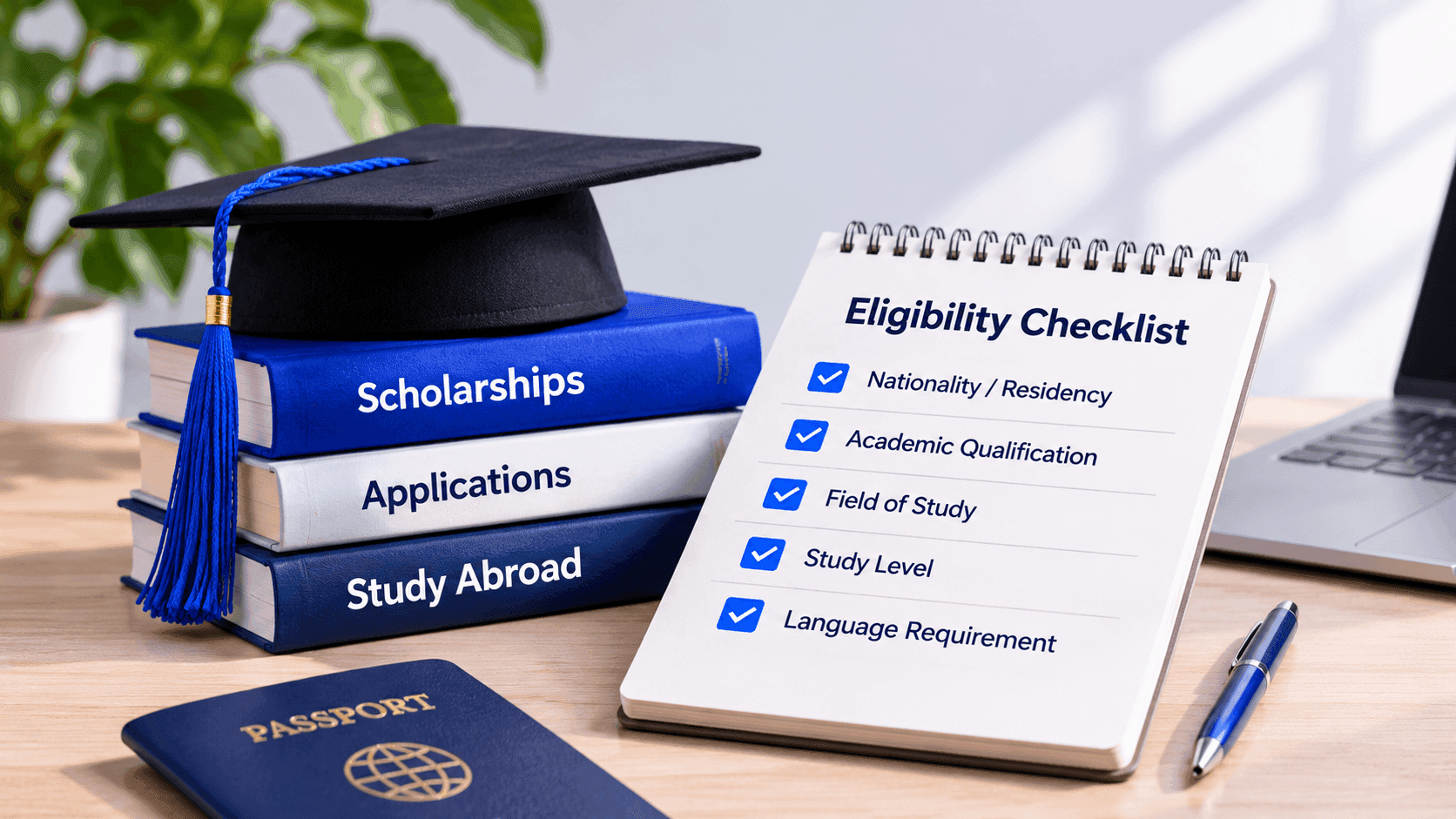
Your Scholarship Eligibility Checklist
Before spending time on your next scholarship application, confirm the following:
- My nationality or residency meets the eligibility requirements.
- My academic qualifications satisfy the minimum criteria.
- My intended course and study level are supported.
- I meet any work experience or language requirements.
- I understand the scholarship's funding coverage.
- I understand any post-study or other contractual obligations.
- The application deadline is still open.
- I can obtain the required documents before the deadline.
- I have identified evidence relevant to the selection criteria.
- I have verified the opportunity through an official source.
If you're uncertain about any mandatory requirement, investigate it before proceeding.
A little research at this stage can prevent considerable wasted effort later.
How Opportuna Can Help You Find and Prepare for Scholarships
Scholarship discovery shouldn't be disconnected from scholarship preparation.
After identifying an opportunity, you still need to evaluate your fit, prepare documents, manage deadlines, and possibly prepare for interviews or assessments.
Opportuna brings these activities together.
With Opportuna, you can:
- Discover relevant scholarships: Focus on opportunities that align with your profile and preferences.
- Prepare application documents: Create and improve CVs, statements of purpose, and supporting application materials.
- Practise for selection stages: Build confidence through relevant assessments and interview preparation.
- Track your applications: Keep deadlines, progress, and next actions organized.
You remain responsible for confirming official eligibility requirements and submitting applications through the scholarship provider's designated process.
Opportuna helps make the journey more focused and manageable.
Stop searching blindly. Start finding opportunities that fit.
Explore scholarship opportunities and prepare stronger applications at www.opportuna.ai.
Frequently Asked Questions
How do I know if I'm eligible for a scholarship?
Start by comparing your academic qualifications, nationality, residency, intended study level, professional experience, and other relevant information against the scholarship's official eligibility criteria.
Pay particular attention to mandatory requirements.
If something is unclear, contact the provider before applying.
Can I apply for scholarships with a low GPA?
Yes, some scholarships may be open to applicants with lower academic results, while others enforce strict minimum qualifications.
Your options depend on the specific award.
Look for programmes that consider additional evidence such as professional experience, leadership, personal circumstances, or community involvement, where their criteria permit it.
Can I apply for scholarships before graduating?
Some programmes accept applicants who are completing their current degrees, provided they graduate before a stated deadline.
Others require completed qualifications when applying.
Always check the specific scholarship's rules.
Do I need work experience to get a fully funded scholarship?
Not necessarily.
Some scholarships require relevant professional experience, while others primarily assess academic qualifications and other selection criteria.
Work experience requirements vary between programmes.
Does being eligible guarantee I will receive a scholarship?
No.
Eligibility means you satisfy the conditions to apply. Selection is usually competitive and may depend on academic merit, relevant achievements, application quality, and programme-specific priorities.
How many scholarships should I apply for?
There's no universal number.
Focus on scholarships for which you meet the requirements and can prepare credible, tailored applications.
A smaller, well-researched shortlist may be more useful than applying indiscriminately to many opportunities.
Final Thoughts
Finding scholarships shouldn't feel like searching endlessly through opportunities that were never meant for you.
The more clearly you understand your qualifications, interests, funding needs, and long-term goals, the easier it becomes to identify scholarships worth pursuing.
Start with eligibility.
Then evaluate fit and competitiveness.
Prepare the evidence that supports your application, stay organized, and verify each opportunity through official sources.
Remember: finding the right opportunity is only the beginning. Being prepared to pursue it is what comes next.